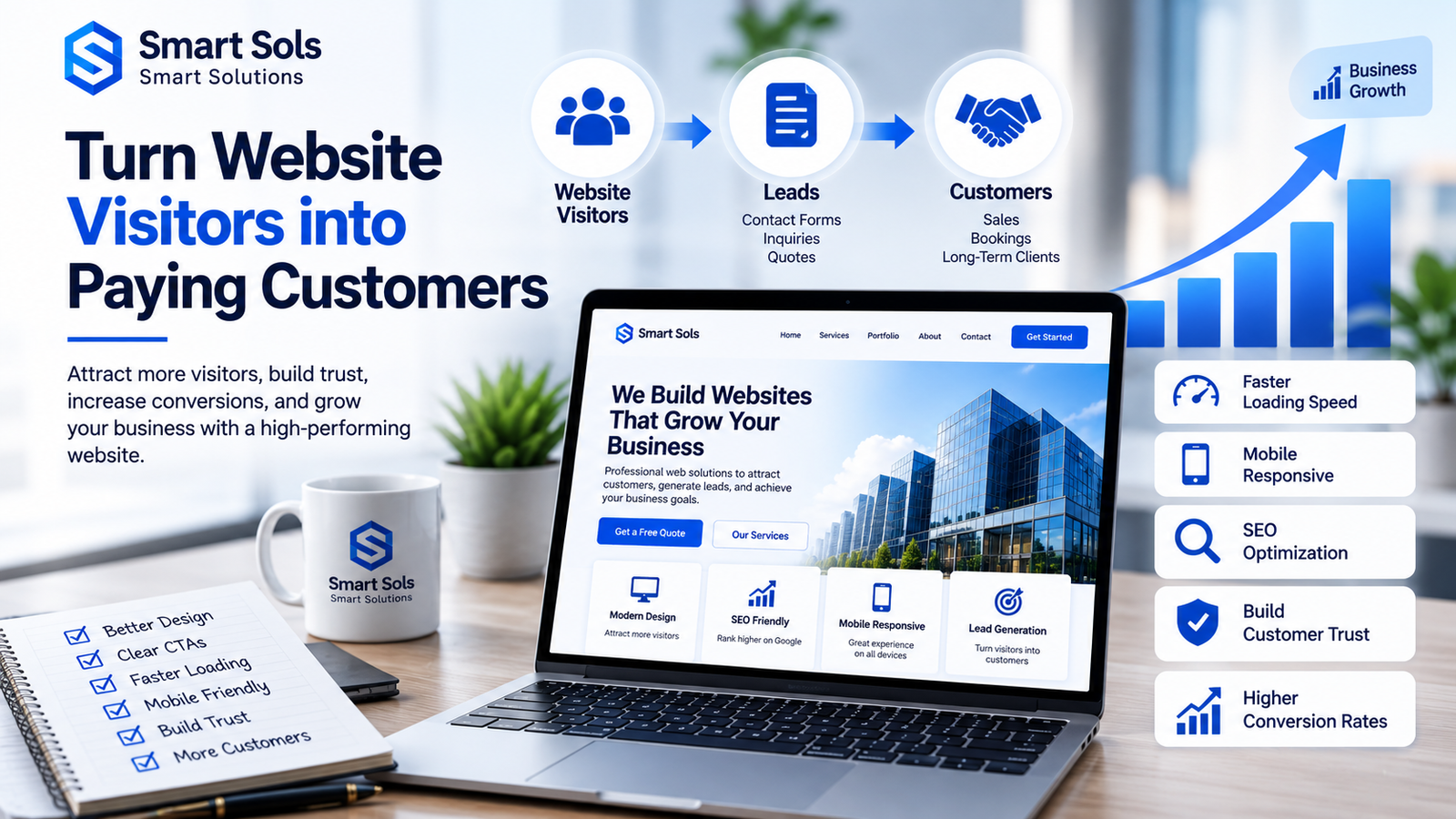
Attracting visitors to your website is only the first step toward online business success. The real challenge is turning those visitors into customers. Many businesses invest in advertising, SEO, and digital marketing but struggle to generate enough inquiries and sales. In this guide, we'll explore practical strategies to improve website conversion rates, build customer trust, and turn more visitors into paying customers.
How to Turn Your Website Visitors into Paying Customers
Having thousands of website visitors does not necessarily mean your business will generate thousands of customers. A successful business website should do more than attract traffic. It should guide visitors toward meaningful actions such as requesting a quote, booking a consultation, purchasing a product, or contacting your sales team.
This process is known as Conversion Rate Optimization (CRO).
Let's explore how to improve your website's ability to turn visitors into customers.
1. Understand Your Target Audience
Before optimizing your website, you need to understand who your potential customers are and what they are looking for.
Ask yourself:
- Who are my ideal customers?
- What problems are they trying to solve?
- What information do they need before making a decision?
- What concerns might prevent them from contacting my business?
Understanding your audience helps you create relevant content, improve navigation, and communicate your services more effectively.
2. Create a Clear and Compelling Homepage
Your homepage is often the first page visitors see.
Within the first few seconds, visitors should understand what your business offers and why it matters to them.
An effective homepage should include:
- A clear headline explaining your services.
- A short description of your business value.
- Professional images or relevant visuals.
- A visible call-to-action button.
- Trust-building information.
Avoid overwhelming visitors with unnecessary information or complicated layouts.
3. Use Strong Calls-to-Action (CTAs)
A call-to-action tells visitors what to do next.
Without clear guidance, potential customers may leave your website without contacting you.
Examples of effective CTAs include:
- Request a Free Quote
- Book a Consultation
- Talk to Our Experts
- Get Started Today
- Contact Our Team
Place relevant CTAs throughout your website, especially on service pages and after important content sections.
Your CTA should communicate a clear benefit and lead to a simple next step.
4. Improve Website Loading Speed
Website performance has a direct impact on user experience.
Slow-loading pages can frustrate visitors and increase the likelihood that they leave before taking action.
To improve performance:
- Compress and optimize images.
- Use reliable hosting.
- Enable browser caching where appropriate.
- Reduce unnecessary scripts.
- Optimize CSS and JavaScript.
- Monitor performance using Google PageSpeed Insights.
A fast website creates a smoother browsing experience and reduces unnecessary barriers to conversion.
5. Make Your Website Mobile-Friendly
Customers frequently browse websites through smartphones.
If your website is difficult to use on mobile devices, you may lose valuable business opportunities.
A mobile-friendly website should provide:
- Readable text without zooming.
- Buttons that are easy to tap.
- Responsive layouts.
- Simple navigation menus.
- Fast mobile loading.
- Easy-to-complete contact forms.
Test your website across different devices to identify usability issues.
6. Build Trust with Social Proof
Customers are more comfortable contacting businesses they consider reliable.
Social proof helps demonstrate that other customers have had positive experiences with your company.
Consider including:
- Authentic customer testimonials.
- Verified reviews.
- Relevant case studies.
- Examples of completed projects.
- Client logos used with permission.
- Clear business contact information.
Avoid fabricated reviews or unsupported performance claims. Genuine evidence is more valuable for building long-term trust.
7. Simplify Contact Forms
Complicated contact forms can discourage potential customers from submitting inquiries.
Ask only for the information needed to start a meaningful conversation.
For example, a service inquiry form might request:
- Name.
- Email or phone number.
- Type of service.
- Short project description.
Additional details can be collected during the sales process.
Make sure forms work correctly, provide clear confirmation messages, and explain how submitted information will be used.
8. Create Dedicated Service Landing Pages
Instead of directing every visitor to your homepage, create dedicated landing pages for your most important services.
For example:
- Website Development.
- Mobile App Development.
- E-Commerce Development.
- Custom Software Development.
- Business Automation.
Each landing page should focus on one service and explain:
- The problem your service solves.
- The benefits for customers.
- Your development approach.
- Relevant examples or evidence.
- How to request a consultation or quotation.
Dedicated landing pages help visitors find information relevant to their needs and can support more targeted marketing campaigns.
9. Use Analytics to Understand Visitor Behavior
Website analytics help identify opportunities for improvement.
Tools such as Google Analytics and Microsoft Clarity can help you understand how visitors interact with your website, subject to appropriate privacy settings and consent requirements.
Important metrics include:
- Number of visitors.
- Traffic sources.
- Landing page performance.
- Contact form submissions.
- Conversion rates.
- Device categories.
- User journeys.
For example, if a landing page attracts many visitors but receives very few inquiries, review its content, CTA, loading speed, and form experience.
Use data to guide improvements rather than relying on assumptions.
10. Test and Continuously Improve
Conversion optimization is an ongoing process.
Small improvements can produce meaningful results over time.
You can experiment with:
- Different headlines.
- CTA button text.
- Landing page layouts.
- Contact form lengths.
- Service descriptions.
- Trust-building elements.
A/B testing allows you to compare different versions of a page or element, provided you have sufficient traffic to interpret the results.
Focus on measurable improvements rather than changing multiple elements without a clear objective.
How to Calculate Your Website Conversion Rate
Your conversion rate measures the percentage of visitors who complete a desired action.
Conversion Rate = (Conversions ÷ Visitors) × 100
For example, if your website receives 2,000 visitors and generates 60 qualified inquiries:
Conversion Rate = (60 ÷ 2,000) × 100 = 3%
This means 3% of visitors completed the selected conversion action.
A good conversion rate depends on your industry, traffic quality, offer, and conversion goal. There is no universal benchmark that applies to every business.
Common Conversion Mistakes to Avoid
Businesses often lose potential customers because of:
- Unclear service descriptions.
- Hidden contact information.
- Slow website performance.
- Complicated forms.
- Poor mobile usability.
- Weak calls-to-action.
- Lack of trust signals.
- Landing pages that do not match advertisements.
Addressing these issues can improve the experience for potential customers and increase the likelihood of meaningful inquiries.
Conclusion
Increasing website traffic is valuable, but converting that traffic into customers is what creates measurable business results.
By improving your website's design, speed, messaging, trust signals, contact forms, and landing pages, you can create a better experience for visitors and support business growth.
Remember that conversion optimization requires ongoing measurement, testing, and improvement.
Ready to Turn Your Website into a Business Growth Tool?
At Smart Sols, we help businesses explore professional website development, mobile applications, and custom digital solutions tailored to their requirements.
Visit https://smartsols.net or contact info@smartsols.net to discuss your next digital project.